
Position before Action – are you prepared?
In our School of Lightness, Ecole de Légèreté, we emphasize the principle of “Position before Action,” rooted in François Baucher’s saying: “Position precedes the action.” Like the Scout motto “Be Prepared,” this idea applies to many situations.
For me, it means not asking your horse for anything until you’ve prepared yourself. Adjusting your own position and posture enables your horse to do the same, which is crucial for actions that occur moment by moment.
In schooling, it’s natural to plan ahead—especially when riding a series of patterns or movements (e.g., halt at X, canter at A, change rein at M). You mentally prepare, adjusting your balance, reins, and aids for the next move. But how much time do you give your horse to prepare? A 600kg horse needs more time to slow down, rearrange and rebalance than a 60kg rider.
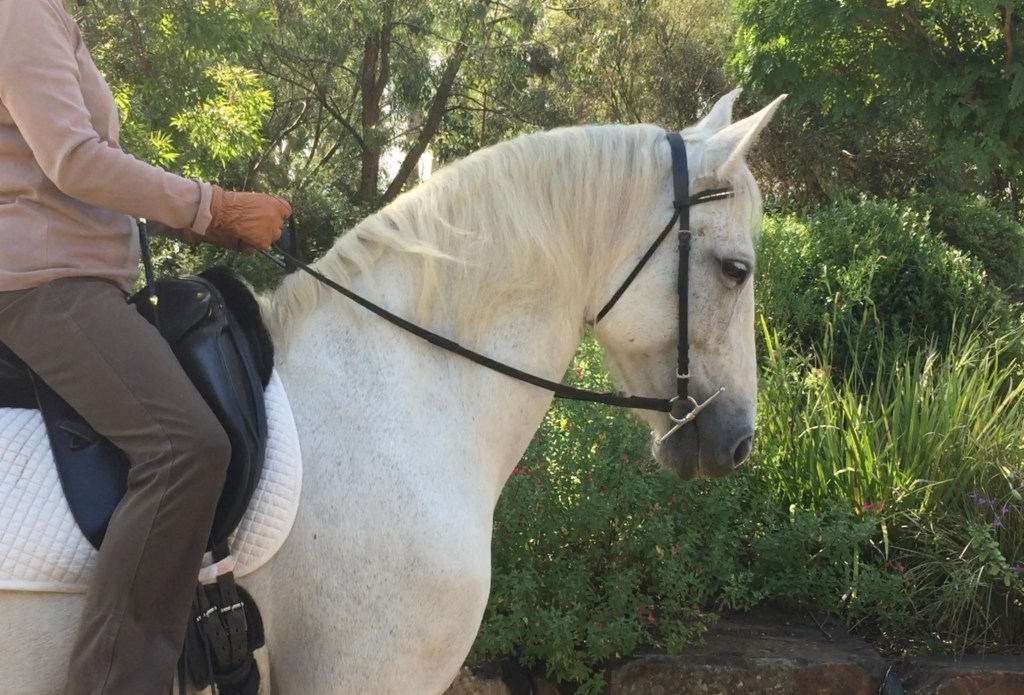
Today, I practiced “Position before Action” while collecting the walk into a halt. I still have to remind myself – be tall in the saddle, lift my head and sternum, lengthen my spine, spread and release my shoulders, ground my elbows, breathe deeply, sit balanced on both sit bones. Invite her to lighten from a stable core and softly carried hands, offering space for her to connect and find balance. Give her time to sense me, to be aligned, upright, balanced, proud, light in her shoulders, in self-carriage. Descent de main, Descent de jambe. (Drop the hands, drop the legs). Praise
Embody the change you want
Alita began to mirror my posture, and find new balance. Her withers lifting in front of me, her neck softly arched as if elevated from above. Her poll reaching higher, her mouth soft, her thoracic sling and belly engaged, as she seeks my hands. Her back rising up to support mine. She is light, active, and feels full of ready energy, yet her steps are placed gently and gracefully. It feels awesome, for a few moments. But can we take it into a halt?
In my moment of joy, I lost focus and forgot to prepare my position for the halt, and then needed too much rein, disrupting the flow. She sensed it and didn’t hold her posture, drifting to the inside and falling into my hands. So, we started again, regained the connection, and finished on a good note, a halt in fine balance, square on all four, giving the mouth, in Ramener, then praise and long reins for a dismount.
I’m sharing this moment in time to highlight how embodying the posture you want from a horse allows them time to find the right balance to respond. (It’s a lot quicker to do it than to describe it here!)
Success with ‘Position before Action’ hinges on what you’ve already taught your horse. How clear, consistent, concise and precise you are will determine your horse’s ability to predict what’s coming next. These are all the classically conditioned cues, signals, words, positional changes etc. that make up your personal language and ‘secret’ conversations. Horses like to get it right, and dislike surprises.
Predictive Text for Horses
Like the predictive text on your phone, you consider how to help your horse prepare for the next movement. If you desire a smooth, balanced transition, you need to teach your horse to read your cues, allowing them to predict and prepare. Your ‘Position before Action’ cues set your horse up for success by giving balance cues ahead of time.
- What do I need for nice contact? Balance.
- What do I need for smooth transitions? Balance.
- What do I need for straightness? Balance.
- What do I need for an accurate turn? Balance.
- What do I need for laterals? Balance.
Almost everything is easier when the horse is balanced. The challenge is, knowing how to position your body cues to help the horse’s balance – both laterally and longitudinally – for the many little things you ask a horse to do.
In Summary – gaining a sense of control
‘Position before Action’ is helping a horse understand what’s on your mind before you ask. It means conditioning them to a swag of reliable cues for the changes you want, so they can predict what they need to do to. The more successful predictions they make, the more at ease and confident they become in their ability to control their interactions with us.
Further, each time you sense a loss of balance, don’t ignore it. Slow down to address it, calmly, on the spot if you can, with positive optimism and positive reinforcement, to make it easier for the horse to predict and succeed with what you’re asking, or at least on the next attempt.
Practical examples of ‘Position before Action’
Would you like to hear more, or how to apply it in practice? I made a list of practical examples and tips on how to prepare a horse’s balance and lightness using ‘Position before Action’. I focus on the following 8 topics and for each one, I share useful examples you can put into practice straight away.
- PREPARING YOUR BALANCE
- PREPARING TO GO
- PREPARING TO SLOW
- TEACHING SOMETHING NEW
- PREPARING CONTACT
- PREPARING TO TURN
- PREPARING SIDEWAY MOVEMENTS
- PREPARING TO SUCCEED
Get in touch to recieve a copy via email. Ask for “Practical Tips on Position before Action“
It’s FREE, but don’t forget to drop me a line to let me know how you get on.
Warm regards, Susie


 Classical Riding & Dressage - Susie Walker
Leave a reply to zainabclark Cancel reply