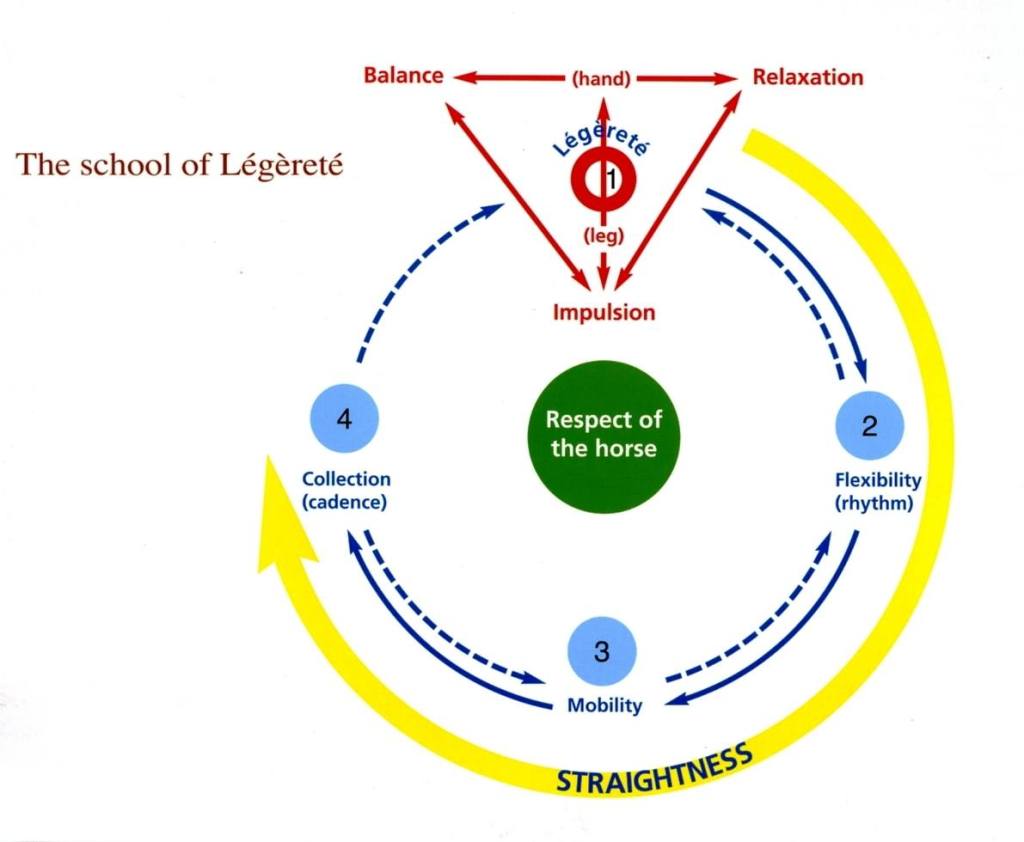
It’s a fail safe recipe. These three qualities (the initial Step 1 of the Training Circle) are the foundation for all we want to do with horses. Without these basics, achieving other qualities (such as in Step 2,3,4) is problematic, and true collection impossible.
So, how does this circle work, and how can you use it?
Step 1 – Initial Légèreté / Achieving lightness (to hands, legs, seat), are the building blocks to establish and take onwards, forward around the circle into… Step 2 – Flexibility (changes of neck position: up, down, left, right, in all paces, and thereby developing rhythm) leading logically into Step 3 – Mobility (lateral work, sideway movements, and transitions within and between the gaits) naturally progressing then into Step 4 – Collection & Cadence.
Thats quite a simplified explaination but not a bad place to start. Better you get some ideas than overlook it as too complicated. But let me go a little further into this. Its important to understand that this process is a circle, a dynamic one, with feedback arrows going both ways – its not a one way street. Nor does it have separate independent elements to tick off and forget. For example, you may start to achieve reaonable Lightness (with some relaxation, balance and impulsion) and then take those with you into the exercises which develop Flexibility. Where at that stage its possible (and likely) to lose some balance or relaxation, or impulsion, and so needing to back up a bit to better consolidate those qualities before progressing.
Further to note, is the yellow line, all the way around the outside, representing the quality of Straightness (Because of its never ending challenge and importance at every stage in a horse’s training, from early leading to the most advanced work, like a yellow thread running through all levels of schooling).
But, if we have the end in mind, lets get back to the beginning – the focus of this post; Step 1 – Initial Lightness (emotionally and physically relaxed, balanced, and willingly reacitivity to the legs) is quite a project in itself. Relaxation and impulsion are an interesting combination. Too much activity, and the horse is not relaxed, it can run through or ignore our aids. Too much relaxation, the horse lacks reactivity. We need a balance between the two. That in itself is interesting, as when we have relaxation and impulsion, we can improve balance. And, we can never have too much balance!
Nothing productive happens without a relaxed horse
Relaxation is the priority for all we do with horses. It’s evidence that a horse is ready to learn. Nothing productive happens without it. If a horse is not relaxed… we must find a way to help it relax, but we also need to know the differences between fear, tiredness, pain and resistance. Reading the signs, being attentive to the slightest body language is the first key to minimising tension and creating relaxation.
I can’t ignore any tension in the moment it happens. My safety relies on my ability to notice small signs of tension. With empathy, I can establish trust so each moment becomes an opportunity to learn, to feel safe, brave, and free. This way, we help a horse feel understood, rather than over-faced.
It would be the same for us. I don’t want to be ignored or pressured to do something I’m not comfortable with. Like a horse – I need reassurance, empathy and confidence. Impatience or force will only make it worse. I also want to feel that you understand my situation, my fears or concerns, my instincts, habits and needs.
Horses are forgiving, but they also have photographic memories, and forget very little, so they are great teachers for us. They teach us to plan ahead, and then to forget it and be flexible. They teach us the importance of being relaxed, balanced, trustworthy, consistant and composed. They teach us to be aware of our own body language, to be clear, mindful, precise and timely, and hopefully to notice how little things mean a lot, maybe to be a little self deprecating, but mostly to be as kind and forgiving of their mistakes as they are of ours.
This has been an introduction to the School of Lightness Training Circle. For more information I suggest you learn from qualified and Licenced Légèreté Teachers or go to the source – Philippe Karl in his book “Twisted Truths of Modern Dressage” by Cadmos. Or direct to his website: Ecole de Légèreté (School of Lightness) https://www.philippe-karl.com/
Happy horse times
Susie


Leave a Reply