
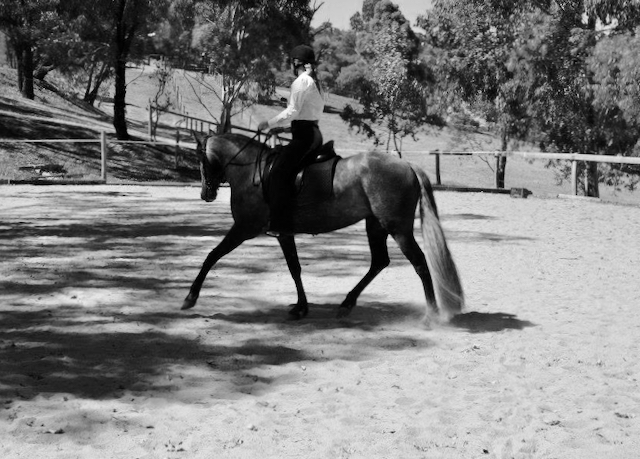
START LIGHT – TO GET LIGHT
If you never start light, you never give your horse a chance to be light.
Horses hate surprises. Yet, riders often begin with too much force – pulling on the reins, dragging on the lead rope, or spurring for more forward. To the horse, this sudden pressure can be a rude shock, and cause them to brace against us.
Watch horses at feed time; the most subtle signals determine who gets priority access. Horses quickly learn how to respond to these cues. Yet we, as humans, can struggle with being clear and precise in our communication.
If we don’t start with soft and subtle cues, horses don’t have time to prepare their own mind and body for what we’re asking. A ‘surprise attack’ can trigger a defensive response, be it freezing, fleeing, or fighting – they resist, just as we would.
Horses are wired to detect the tiniest changes in their environment, yet some riders use excessive, sustained pressure as if the horse was immune to lighter aids or visual cues. But think about it: if a horse is sensitive enough to feel a fly land on its coat and twitch it away, why do we believe they need so much force to respond to our cues? A habit of heavy aids can desensitise a horse, and fool you into thinking you need even more pressure.
Horses can learn to endure pain and excessive pressure, not because they have a hard or insensitive mouth, or sides of iron, but because they haven’t learnt how to escape it. Others might try to resist or avoid pressure in creative ways, not out of naughtiness, but because they’re confused, or have learnt to remove pressure with these behaviours.
In both cases the training has failed to teach the horse how to respond to more subtle cues, and how to find freedom through the right response. A common reason a horse becomes unresponsive is from conflicting signals – strong reins used with strong legs, at the same time. This sends mixed messages that confuse and de-train the basic responses of stop, go and turn. It’s not the horse’s fault – it’s a habit we, or someone else inadvertently created.
Horses already have the ability to respond to light cues, evident in how they aptly learn to anticipate and predict actions, through Classical Conditioning. Knowing this is one of the most powerful tools a trainer can harness. Imagine the lightest cue you can start with, use it consistently before escalating, and remove it as soon as the horse starts to do what you ask.
Start light. You don’t need a sledgehammer to crack a peanut. If things get blurry for the horse or heavy for you, check the basic responses. There is no point working on canter to halt, if a walk to halt is dodgy. Separate the aids to keep them simple. Hands without legs, and legs without hands. Check yourself first – can you be more precise and patient with less?
See how little pressure your horse can feel. Can you teach them to stop without the reins – if you just breath out …sit tall, and stop going with the movement? Horses make good use of Classical Conditioning with each other. We can too.
You might be surprised what you can teach a horse when you focus on doing less. Lightness is fun. One day, just preparing your mind and body for a movement will be enough – your horse will sense what’s coming and offer it to you. This connection is a gift worth our effort.
Happy horse times, Susie
 Classical Riding & Dressage - Susie Walker
Leave a comment