
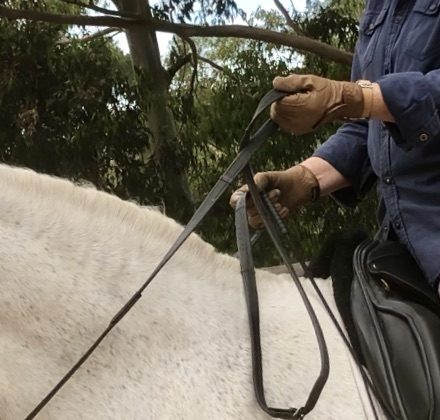
Role of our Hands in Horse-Rider Communication
Achieving a harmonious connection between a rider’s hands and a horse’s mouth is fundamental for effective riding. Yet the journey to this connection, is often fraught with tension, both in the horse and the rider. This article examines essential concepts of balance, relaxation, and contact, and their impact on horse-rider communication. By addressing lateral and longitudinal imbalances, and the role of hands in guiding and educating the horse, we outline the critical steps in establishing a reliable and responsive partnership. Delve into the techniques and principles that underpin successful equestrian practice and learn how to resolve common issues related to tension and imbalance.
Giving the Mouth
Giving, releasing & relaxing the mouth, mobilising the jaw, tasting the bit, giving to the bit, accepting the bit, balanced in self-carriage, relaxed “in the hand” – what do these terms mean to you, and why do they matter?
How do you know if your horse is relaxed and accepting contact or anxiously avoiding a connection to your hands? Have you found the connection you dreamed of having?
Most riders aim to ride with ease and lightness, ensuring their horse is happy and comfortable. However, many riders experience long periods of frustration and confusion. Horses are sensitive creatures and usually try to cooperate. So why does it take a long time to achieve ease and lightness?
For the most part, this problem arises when trainers, coaches, or riders overlook the importance and simplicity of balance – the horse’s balance under the rider. The path to ease and lightness can be found through balance. A horse in balance is light and easy to manoeuvre in any direction or pace, and is also more likely to be relaxed and willing.
Tension from Imbalance
A ridden horse with imbalances, either laterally or longitudinally, is not relaxed. Tension in the mouth (in the contact) creates contractions and resistances through the whole horse, through the jaw, poll, neck, through the spine to the tail.
Lateral imbalance can be felt in the hands. The horse overloads one side, pulling or grabbing the bit on that side. This is also referred to as falling in or dropping a shoulder.
Longitudinal imbalance is also felt in the hands. The horse can reverse the neck, lean on the hands, hide behind the hands, or overflex behind the vertical. These imbalances can also naturally be felt through the rider’s seat and legs.
Naturally Wobbly
Most riders know that horses are naturally asymmetrical, like us, but not many know how this reflects in the contact or the remedies to correct asymmetry. Balance and straightness start at the very beginning with groundwork, gymnastic lunge work, and classical work in-hand in the bridle before a horse is ever ridden, continuing until the end.
Under-saddle, riders need to consider if their own asymmetry or lack of useful balance is impacting their horse. Resistances felt in the horse can create resistance and imbalance in the rider. A tense, crooked, or unbalanced rider adds an extra burden for a horse, which has to compensate for this in all movements, like us trying to run while carrying an unbalanced load, creating tension and resistance.
Shift Brace to Balance
A horse that is not relaxed in the contact will be bracing, preparing for something difficult or unpleasant. This brace causes a loss of balance, so the horse will not release the jaw or give its mouth.
The loss of balance occurs with the brace in a redistribution of weight to either one or both forelegs: leaning on one or both hands, coming above and hollowing, coming behind, leaning on one shoulder, or a combination of these resistances like tilting, twisting, grinding, etc. The horse searches for answers to unresolved pressure. When they find the answer, relaxation, balance, and lightness can be restored. While there is tension and imbalance, the horse is less inclined to focus on other tasks.
Nothing productive happens in tension. Continuing to school a horse in tension gives practice time to a tension habit, and horses, like us, get better at what they practise.
Key to the House of the Horse
The hand is our main communication line to the mouth, the door to the horse’s mind and body. The key to this door is a relaxed and mobile jaw. Don’t fool yourself into thinking hands are unimportant, and that all you need is seat and legs!
Yes, the seat, weight aids, and legs are important and become more meaningful as classically conditioned cues as the horse’s education increases. But only once there is a trustworthy connection to the hands – be it through a bit, a cavesson, a halter, or a neck ring.
Role of the Hands
The hands teach a language of aids and create a conduit for mutual trust and dialogue. They serve to relax the horse, ask questions, make suggestions, invite effort, suggest changes, guide, re-position, re-balance, acknowledge, reward, enable, cue, and educate. They can act upwards, outwards, sideways, forwards, but not pulling backwards in a trial of strength.
The hands teach a code of cues to signal precise messages: with demi-arret to raise or lighten the forehand, with descente de main to give or release, with action-reaction to relax or lower the neck, with neck-reins to straighten or rebalance the shoulders, with direct or indirect reins for turns or lateral work, to bend the neck, or with an upward-outward turn of the wrists to ask for the mouth. Over time, this code becomes more subtle and personal between horse and rider, eventually teaching the horse to respond to fine weight, seat, and leg aids. Then we barely see the hands in use.
If you feel you are using just seat and legs to achieve poll flexion or self-carriage, check that you are not fixing and blocking with rigid hands, expecting the horse to obey without consent onto or behind a “hand held frame.” If you have weight in your hands for longer than a few seconds, you could have fallen into the habit of carrying your horse in your hands instead of carrying your hands in your hands. Similarly, if you habitually see-saw the reins left/right all the time, this is very difficult for a horse to endure and tends to create resistant, heavy, or over-bent horses, and insensitive hands for you.
It is a journey. Not easy, but much harder without the horse’s consent or balance, evident through a soft mobilisation of the jaw, and the horse’s self-carriage.
Three Steps
If you teach your horse to relax, accept, and trust your nice hands, you’ll have the key to teach a language of aids to progressively create the balance and understanding needed for self-carriage and collection.
First – Ensure your own balance is helping and guiding, not hindering. Be an easy load for your horse to carry, with your weight always – in the direction of travel. This way, you start from a good position to help your horse find relaxation, balance, and impulsion.
Second – Create a trustworthy connection to the mouth. Be there for your horse: following, allowing, guiding, giving, and releasing promptly as needed to give a steady and soft connection to the hand – like holding hands. Remember, it’s the release that trains, not the pressure. Willingness comes when you help your horse find the answers, one question at a time, keeping it clear and simple.
Third – Know how to improve a horse’s balance, laterally and longitudinally, to school in a healthy way. With an educated hand, and a few keys in your pocket to release the jaw, relax and rebalance the neck and shoulders, and lighten the forehand in a poll-high position, you can improve balance. With this, you can achieve ease and lightness, and a happy horse. These are the foundational tools we use in the School of Lightness (Ecole de Légèreté).
For more information or lessons, please get in touch.
Happy horse times, Susie
 Classical Riding & Dressage - Susie Walker
Leave a comment