
ON, IN FRONT OR BEHIND THE VERTICAL
Often we see horses being ridden in a posture that is too ’round’, ‘curled under’ or ‘over-bent’. It may be due to lack of knowledge of how to work the horse correctly, or it can be the horse avoiding contact, trying to hide behind the hands. If the horse has at some stage been in side reins, ridden with fixed or low hands, with a martingale, or some other restrictive device, it is quite likely that this habit is present.
It may also be that the rider is asking for this position, thinking that this is the way to find collection, or being advised to “keep the horse in a frame.”.. but nothing could be further from the truth – this is not the way to find contact, collection, harmony or balance. Whatever the reason, we must acknowledge that when a horse is curling under, behind the vertical, it is not willing to accept contact with the hands. This is commonly shown by a loop in the reins – giving the rider a feeling that the horse disappears in front of us and refuses to seek contact with our hands or work confidently up into the contact. Ongoing, this is incredibly damaging to the mental and physical welfare of the horse.
PREVENTING COLLECTION
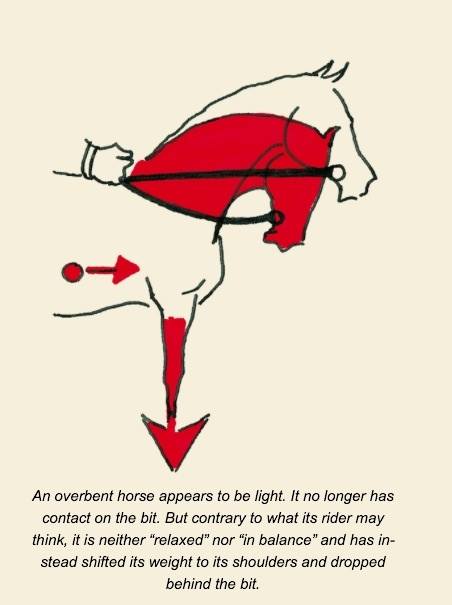
Collection will never come when a horse is worked behind the vertical. This is due to the loss of confidence and balance it creates, as the horse overburdens the front legs and works more ‘downhill’ onto the forehand. Collection is about teaching the horse to carry itself in a more naturally ‘poll high’ balanced position, the nose on, or a little in front of the vertical, light in the shoulders, and with more weight behind, in relaxation, balance and impulsion, uphill.
Curling under, once established as a habit, can be a difficult thing to correct. The rider needs to be vigilant and quick to open the poll and the gullet, with forward-upward actions (not backward actions) each time the horse tries to avoid contact or come behind the bit.
Importantly, the rider also ensures that while riding forward, they have an allowing following contact – in sync with the horse’s motion and natural head nodding, hence, not giving the horse any reason to fear the hands.
Encouraging a horse to open its poll and raise its neck and head to a natural pol high position is a respectful and effective way to correct this problem – as long as we remember to lower the hands straight back down again each time after opening the poll! Rounding is not about forcing ‘a frame’ it is about teaching the horse to accept and trust the hands, to bend the neck, extend the neck, raise the neck, and then eventually from a poll high position to seek toward and “into the hands”.
RUNNING BLIND
Otherwise, in an overbent posture, the horse is running blind, and how frightening it must feel to be made to run without seeing where you are going. In order to coordinate posture and movement for balance; a horse, like us, has 3 points of reference: The ground, gravity and the visual environment.
The quote and illustration shown here is from “The Twisted Truths of Modern Dressage” by Philippe Karl
“…However, we know their binocular visual field has a limited angle and can only see a long way into the distance when its head is lifted and the poll open. (alert posture). Once the horse is overbent it only has limited sidways (monocular) vision, and binocular vision that only allows it see where its putting its feet. It is made to move almost blindly”.
When humans have to deal with conflicting points of reference, the chance of balance disorders is increased – (ie sea sickness, loss of balance). There is no reason why it wouldn’t be similar for horses.
#balance #classicaldressage #contact #horsetraining #Legerete #Lightness #relaxation #thehands
 Classical Riding & Dressage - Susie Walker
Leave a comment