
When a horse is ‘falling in’ on a circle or cutting corners, the common idea is: “more inside leg”. But often, this is not solving the problem, and can even make it worse, as horses tend to switch off to a constant nagging leg, and riders tend to ‘fall in’ themselves with that pushing leg.
I was riding for many years before discovering how much easier it is to balance and straighten a horse with neck reins and weight aids. So I’m keen to share it with you.
A horse’s crookedness or natural asymmetry is often referred to as their individual laterality. Like us – horses usually do things easier one side than the other. Its not a big problem in nature until a horse becomes domesticated and has to carry a rider. In riding, the first problem we notice is how a horse is easier one way, and more idfficult the other.
Illustrations and inspiration by Philippe Karl ‘Twisted Truths of Modern Dressage’ Cadmos.
A RIGHT BENT OR LEFT BENT HORSE?
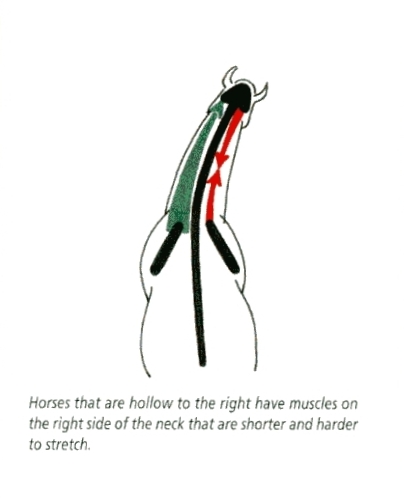
Horses can be referred to as being predominantly right bent (right hollow) or left bent (left hollow). A right hollow horse has muscles on the right side of the neck that are shorter and harder to stretch. As an example, lets take an asymmetrical ‘right bent’ horse going around a circle to the right seems easy and the circles tend to get bigger because the horse easily bends to the right, and often falls out to the outside left shoulder. On the other rein, going left, it tends to ‘fall in’ and overloads or ‘drops’ the left shoulder. To do this he will tend to shift more weight to his inside (left) shoulder, tighten or pull down into the left rein, place his head and neck to the outside (right) and swing his quarters to the right, bulging his belly into our left leg. Like a banana bend, but the opposite bend to the curve we’re on. See below: (i.e. circles to the left become smaller, while to right they seem easier or become bigger).
If you have a left bent / left hollow horse – you’ll need to flip this image and logic.
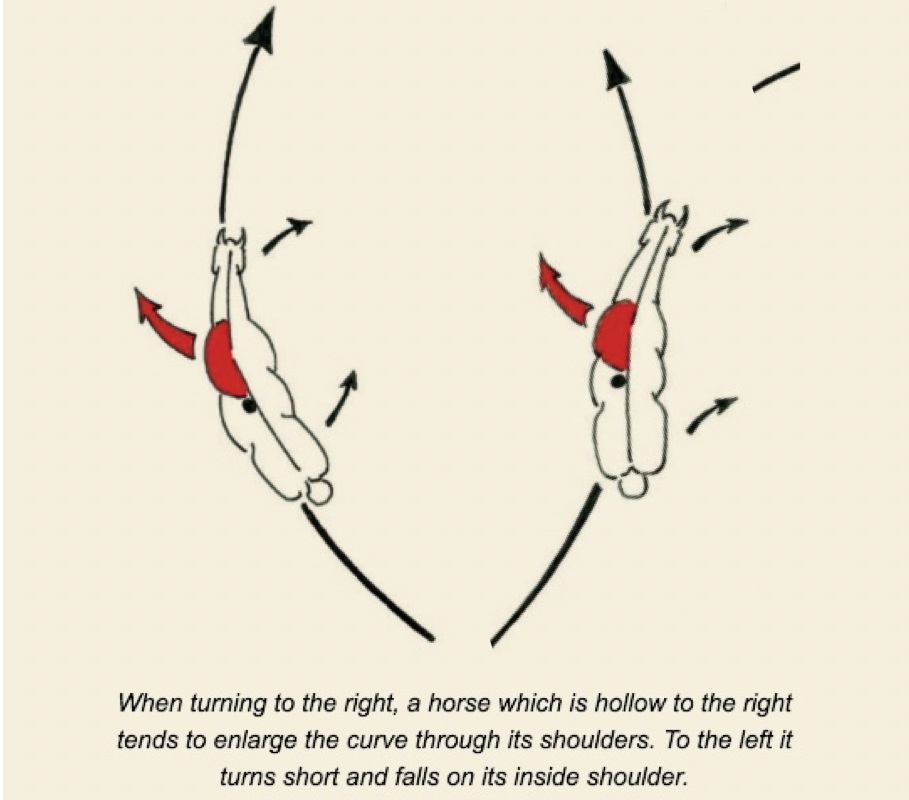
RE-BALANCE THE SHOULDERS
If we push more with an inside leg, to physically force the horse to move over, we also become part of the problem. A light inside leg at the girth can be a useful reminding aid for the horse to move away from pressure, but when the horse ignores an inside leg, pressing stronger with it is missing the point. When something isn’t working, doing more of it doesn’t make sense! Either the horse doesn’t understand what you want, or doesn’t have the ability or balance in that moment to do what you want. We can naturally realign the horse’s shoulders with more clever aids.
NECK REINS & WEIGHT AIDS
To help the horse, we need to think about the balance mechanics of what is happening; the cause and effect of the horse’s natural asymmetry. The horse can’t be blamed for being born “right bent”. In order for a horse to drift off line, or change direction, one side or shoulder will be overloaded. Gravity takes over to cause the drift, and equilibrium is lost. But we can recover or improve balance by teaching specific rein aids, and in particular the “neck rein” to realign balance equally over both shoulders.
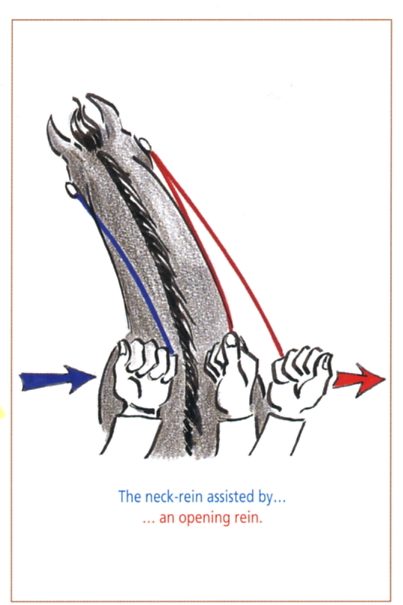
Neck reins are quickly effective in shifting the horse’s shoulder balance, but need to be supported with equal tension in both reins, and with upward-sideway actions of both hands, (not backwards, not pulling, not see-sawing). Aim to keep the middle of the bit in the middle of the mouth, and at the same time sit a little more to the outside, so your weight aids assist the balance you need, i.e., balance into the direction you want the horse to go, to encourage him to follow that balance.
THE POWER OF COUNTER-BEND
Effectively this is making use of counter-bend. The horse will be flexed slightly away from the direction of travel, in counter bend. Biomechanically, this makes it easier for the horse. The horse’s neck is like a lever, it naturally transfers weight opposite to the way the head is flexed or bent. When the head is bent left, the horse can more easily shift weight to the right shoulder, and tends to go that way. If you are a visual learner, like me, you might want to go and get something bent, like a banana or something like play dough to ‘see’ the logic of this.
Balance and weight aids are important if you want to progress and keep your horse sound. If the horse drifts to the left, we can help correct this by transferring more of our weight to the right fore. The rider stays upright, but sits and balances a little to the right with more weight down into the right stirrup and right seat bone.
If the horse resists, you can touch with the whip / tap on the inside shoulder to encourage him to come off that shoulder. To re-balance his load, the horse is then more inclined to move underneath your weight – to follow your weight and move to the right, as you want. Praise and reward with a softer rein as soon as you feel the shoulders move towards the outside.
STRAIGHTNESS IMPROVES LIGHTNESS
You will know if it’s working because it feels easier and softer in those moments when the horse shifts the weight over, like you have unlocked a blocking resistance or brace. Keep testing, repeating, and rewarding, until the horse well understands the neck reins and weight changes. Use a slow walk to help the horse find confidence balance to use his body differently, and to listen to your new aids each time he falls back into old habits.
It’s a little like us trying to do things with our non-dominant hand. It’s difficult! It takes time and practice to change. But, with balance, comes straightness and rhythm. Without these we can’t progress to more advanced work.
When a horse ‘falls in’ on the left rein, counter-bend is much more effective than turning the horse’s head to the outside (to turn its nose to the right). Inexperienced riders often try to turn the nose where they want the legs to go – but this puts even more weight to the inside shoulder and causes the horse to get better at being crooked.
It is more effective to focus on taking the shoulders and the withers to the outside, using the inside neck rein and outside opening rein (in equal contact) to keep the head and neck bent a little to the left. The bio-mechanical leverage of the horse’s neck naturally becomes its own solution.
PATTERNS TO IMPROVE STRAIGHTNESS AND BALANCE
A simple way to start this is in the pattern of spiralling out of a circle. Flexing the horse’s neck to the inside, and using neck reins and weight aids to widen the circle. Ensure your inside leg isn’t going back behind the girth – as it is not about moving the quarters out – as it’s the shoulders that control the steering, we need to keep the inside leg at the girth and think about shifting the balance of the shoulders to the outside, with our balance and rein aids.
A common mistake is that the rider tends to give away the outside rein, the outside elbow and arm escape forward away from the body, and the outside seat-bone comes off. Without support of the outside rein and weight aids, the horse tends to over-bend the neck but not shift weight to the outside shoulder.
As the horse starts to understand how to rebalance the shoulders to the outside it’s then good to teach shoulder control on a diagonal line – from the three-quarter line to the long side. On the left rein, turn up the three-quarter line for a few meters, then with neck reins, and weight aids, ask the shoulders to yield back to the track. With left flexion, send the shoulders and withers to the right. Your right hand guides and leads the shoulders back to the track. Your left hand follows against the neck.
It’s a similar pattern to a leg yield but it’s a ‘shoulder yield’. Stay parallel to the long side but don’t take your inside leg back – as that talks to the hind quarters and will confuse the balance. Think of a shoulder yield – asking the horse to take wider steps, the front legs cross over each other, to the right and across to the fence/wall.
Progress to trot. It’s easy in trot to use weight aids while you are in the air. If you are finding it easy, a more advanced pattern is to ride a figure of 8 but keeping the SAME bend & flexion, while changing the direction. (i.e. one circle in true bend and one circle in counter-bend). If you can master this on both reins, you will have progressed well with shoulder control, and your circle shape and size will be more accurate.
A NATURAL BREAKTHROUGH TO LATERAL WORK & COLLECTION
In a short time you will need less counter-bend, and a light touch of a neck rein with a slight shift of your weight should be enough to correct any loss of balance. This way you will feel how your balance leads the way and the neck reins control the shoulders. It’s a breakthrough to relaxation in rhythm, a stepping stone to lateral work and a prerequisite to collection.
NOTE: Often we are working on shoulder control under saddle, but these corrections are best started from the ground, in leading, lungeing and in-hand work in the bridle. Without the extra burden of a rider, this work can all be done in-hand to help a horse become equally strong and balanced left and right before being started under saddle.
 Classical Riding & Dressage - Susie Walker
Leave a comment